
The Official 3D Modeling Thread (Ask, Showcase, etc.)

^ He probably want's one of use to make these for him to use on his newest jet coaster.
@Jetcoasterfan Do you have more pictures of this ride for me / an RCDB link?
I might give modeling this train a try if I have some spare time this summer. NO PROMISES THOUGH
I solved the rotation issue by adding an empty as the parent of both. The gates rotate fine now, but the location is really weird. I tried applying the location in Blender, but that made the rotation even worse and didn't fix the location.

Got it working now! Had to remove the location from the keyframes.
I really wonder why you didn't use the ingame platform? It's perfect.
I wouldn't consider it perfect, especially not if you're making a recreation of an existing coaster. I can't have the default gates and the annoying horn from the default ingame platform.

So if u leave the platform out from the station, the horn doesn't sound ?
I can confirm, thats correct
Hello,
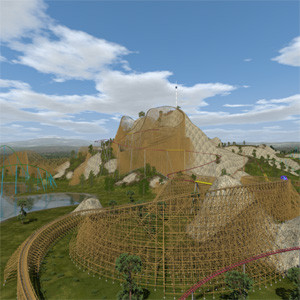
i have made sucessfully simple objects with anim8or, exported them as 3DS-Files and imported them in NoLimits. It works, but you must consider, that anim8or has measuring units in inch (= 25.4mm or 0.0254m). If you want to make objects that fits in NoLimits you have to convert units used in NoLimits to inch. It is very easy to make signs for your park ("Exit Only", "Entrance", signs with name of Roller Coaster and some technical data as you can find on many transportable coasters in germany e.g. Oktoberfest etc.), simple buildings (e.g. houses, more shops for snacks and drinks) should be also no problem. Selection of benches, fences and lamps in NoLimits is very good, but some other parts have to be made individually.
Now i want to make my own stations. No Problem, as the station is a static object without moving parts because i want to use the stations from NoLimits with "gates only". But you need the exact dimensions of the station. The length is defined by the position of type separators on the track. But the width (entrance side resp. exit side for "unloading only" stations and opposite side, that is narrower), height of floor above track and gap width in floor for track and train are defined by selected roller coaster.
I have measured dimensions for some coaster types i have used until now:
Classic Steel Roller Coaster:
width of entrance side resp. exit side from center of track: 4.90m
width of oppsite side from center of track: 3.40m
height above track: 0.50m
width of gap from center of track: +/-0.65m
Classic Steel Roller Coaster (modern):
width of entrance side resp. exit side from center of track: 4.90m
width of oppsite side from center of track: 3.40m
height above track: 0.54m
width of gap from center of track: +/-0.65m
LIM Launch Coaster:
width of entrance side resp. exit side from center of track: 4.94m
width of oppsite side from center of track: 3.45m
height above track: 0.67m
width of gap from center of track: +/-0.69m
Wooden Coaster (Trailered 4 Seat):
width of entrance side resp. exit side from center of track: 4.95m
width of oppsite side from center of track: 3.45m
height above track: 0.32m
width of gap from center of track: +/-0.70m
If you use station without roof, you need outer dimensions for your own buildind, if you use gates only, you have to make your own floor, you need height above track and gap for track and train, but floor and building can be wider than original floor, but it sould not be much narrower. I think, a thickness of floor of ca. 5cm will be enough for all stations. Inverted and suspended coasters do not have gaps for track. I have not looked for floorless coasters if floor mechanics are present when station with "gates only" is selected, it is best to use stations without roof and you make only building above floor.
Some have made own stations, i think they have also some dimensions for other coasters. Is there a list of station dimensions for more (or all) coasters in NoLimits? I have made a test park with a straight track and a station, freezed it anf tried to measure dimensions of stations as accurate as possible. If you zoom as far as possible and look at front of station (i have always rendered station without roof) you can get dimensions with an accuracy of ca. +/-2cm (perhaps depending on screen resolution). I plan to make a wooden station with wooden floor for a wooden coaster to make it more look like an old roller coaster. IMHO the style of default station from NoLimits does not match very good for wooden coasters.
Best regards
@Keven. I sent you more pics of the jet coaster trains!
Hi there
I am currently working to make the (boat) of the Vliegende Hollander smooth for my project. here some renders



Hi! Can somebody make me Mack Big Dipper Cars? Thank you! Also, what kind of track should I use, I was thinking the Mack Launch coaster, but now I'm not sure.
I've just released another tutorial, giving some pointers on good optimisation practises. Be sure to give it a read, let me know if there's anything I've missed

A great article! I hope that it will have an impact since it's so sad to see great looking projects that perform like - it's unfortunate - garbage. At least when these are meant to be used interactively.
Just another addition maybe that hopefully can summarize some aspects with these two images:


Same test scene, that looks identical, but an enormous difference in performance. That hopefully impressively demonstrates that it's not just important how the final result will look, but it's also extremely important how this is achieved. Many projects seem to completely ignore that, either by being unaware of it or - also unfortunate - by using software that give almost no control over these important aspects.
In this case even the amount of polygons is exactly the same. The only difference is that in the slow performing object each building is a single object element (left) while in the good performing it's just a single mesh (right).

Probably both ways of organizing such a object is not the optimal way in real examples, but obviously one is already a better way of doing it. In a real example you would probably split the mesh into parts to clip individual elements, that's a trade-off as well as other aspects might influence design decisions for example if parts of the objects should be able to be moved by scripts. But this test hopefully demonstrate how important it can be to be aware of the inner structures of models and not just the visual outcome when hunting for great performance.

^^ "Stop using sketchup" +1
^But what about all the BUTTONS.
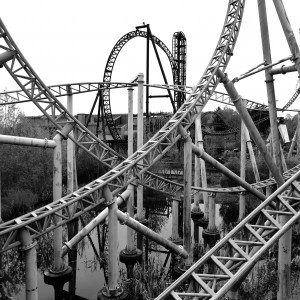
Does anyone have a link for a download for the 6 seat B&M dive coaster cars?

Small question for the skilled 3d people here.
What's the easiest/best way to texture something with large surface areas, like a station or other scenery buildings, when using uv mapping? And while keeping the textures nice and detailed looking..
I'd like to learn a good way to texture buildings that doesn't use sketchup, lol. Cause that's how i do all my buildings at the moment, in sketchup.
And would substance painter be useful for doing buildings? I still haven't gotten round to d'loading the demo yet, hahaha. I'll get there eventually..
As so often there's no perfect one fits all solution but the probably most frequently used approach is using some modular pieces that are assembled to a large building, combined with some clever texture sheet design and UV placement as well as some material shader "magic" to blend two textures for example controlled by a third texture or things like vertex color.
And additionally maybe some tricks to recolor the same texture inside the game engine (NL2).
You can find some good examples online how this is often done like these:
https://polycount.com/discussion/144838/ue4-modular-building-set-breakdown
http://wiki.polycount.com/wiki/File:Modular_MountBladeMod_01.jpg
There are also many free and paid tutorials about this available.
The full workflow like this is done in the unreal engine for example where one can also place things like decals or change vertex colors inside the game environment is not fully possible with NL2 but you can use many of these techniques.
When I do this I use substance painter to help me but I'm actually rather abusing it, actually substance designer might be more helpful for it. I also combined this with some baked ID maps and some normal maps from high poly objects that I baked with blender. Such a building is usually not one single object that can be just painted on, which is what substance painter is actually strong in, but I paint the individual pieces with it.
Actually that's not so far away from what I saw had been done by many in sketchup, but you rather try to use some larger texture sheets instead of using many different textures for example which should have a positive impact on the final performance and overlay for example a second UV map or vertex colors to vary the result in NL2 and get rid of the obvious tiling effect.

My first attempt at using substance painter...

That looks really good!
^^ Nice job, i like that.
bestdani posted on June 30th, 2018
As so often there's no perfect one fits all solution but the probably most frequently used approach is using some modular pieces that are assembled to a large building, combined with some clever texture sheet design and UV placement as well as some material shader "magic" to blend two textures for example controlled by a third texture or things like vertex color.
And additionally maybe some tricks to recolor the same texture inside the game engine (NL2).
You can find some good examples online how this is often done like these:
https://polycount.com/discussion/144838/ue4-modular-building-set-breakdown
http://wiki.polycount.com/wiki/File:Modular_MountBladeMod_01.jpg
There are also many free and paid tutorials about this available.The full workflow like this is done in the unreal engine for example where one can also place things like decals or change vertex colors inside the game environment is not fully possible with NL2 but you can use many of these techniques.
When I do this I use substance painter to help me but I'm actually rather abusing it, actually substance designer might be more helpful for it. I also combined this with some baked ID maps and some normal maps from high poly objects that I baked with blender. Such a building is usually not one single object that can be just painted on, which is what substance painter is actually strong in, but I paint the individual pieces with it.
Actually that's not so far away from what I saw had been done by many in sketchup, but you rather try to use some larger texture sheets instead of using many different textures for example which should have a positive impact on the final performance and overlay for example a second UV map or vertex colors to vary the result in NL2 and get rid of the obvious tiling effect.
Thanks Dani. I'll have a look into some of that info.
I have a general idea of how to uv bigger buildings, but it's probably not the most efficient way to do it. And i didn't want to end up doing massive texture maps to prevent a loss of detail or quality. And knowing my luck, if i tried the modular approach, i'd end up with textures that don't line up properly, lol.
More game related than just 3D, but lately I've succeeded in my dreams of being an Environmental Artist, and have been given a nice role in the game "Hide or Die" to both create props/assets as well as full on level design. One of my latest creations is a level I dub "Gothic" that features an underground catacombs, mausoleums, cemeteries with a nice cathedral to serve as a weenie to the whole level.


Some parts, like the cathedral, the mausoleums area and the catacombs are 100% created by me, while other parts of the level are littered with props and assets that I have access to via project files. This is one of the first big creations of mine since I made the jump into the gaming industry. Would love to hear what some of you think!
If you're interested in the actual game, you can visit our steam page or pre-order the game + beta on our website, it's a 16 player asymmetrical horror game much like Dead By Daylight, Friday the 13th, and many others.
Steam: https://store.steampowered.com/app/731620/Hide_Or_Die/
Website: https://www.vecfour.digital/store
Great work. Maybe I can convince some friends to try it out together when it is fully released.
I'm played a little bit more with the blender 2.8 alpha:
So i finally d'loaded the trial of Substance Painter. Haven't really done anything decent yet, just watching tutorials and playing around. When/if i have something worth showing off, i'll post it, lol. I am thinking about buying the full thing, though. Seems like the sort of texturing program i've been looking for.
To those who use it a lot, any advice or pointers? How do models that have been textured in Substance translate over to NL2?
And is there any way to change the colour of a smart material once it's applied?
Edit: Nm, i figured out the smart material colour thing..
Those trains you can get some huge ejector airtime in right now. I do not see any lap bars. You should just use a old loose seat belt like this.