
Official Testing Criteria - E-Stop, Clearance Envelope Check
First off, here's what we've typically done when it comes to e-stop testing. In general we expect that a coaster can be e-stopped and then automatically recover back to normal operations without manual intervention. Here's how I've been testing things during contest reviews:
- Press e-stop before a train reaches the first block brake. Train must stop without causing a block violation.
- Disable e-stop. Train must continue forward and out of the block brake, making it through to the next block brake.
- If there are additional block brakes, repeat the process with this first train.
- For a launched coaster, attempt to e-stop during the launch to cause a rollback. Train should rollback and stop without colliding.
- Ideally after a rollback stop, train can re-launch without manual movement of the train, however this is not always possible.
The question is how much to penalize the operations score or BT score of the coaster for failing one of these tests? Failing to stop at a particular block is a major fault. Failing to recover and move forward automatically is a lesser fault, but still easily fixed by adjusting the location of the block brake and settings that determine where the train will stop.
What do we all think?
-Ride_Op
Ride_Op posted on August 9th, 2021
First off, here's what we've typically done when it comes to e-stop testing. In general we expect that a coaster can be e-stopped and then automatically recover back to normal operations without manual intervention. Here's how I've been testing things during contest reviews:
- Press e-stop before a train reaches the first block brake. Train must stop without causing a block violation.
- Disable e-stop. Train must continue forward and out of the block brake, making it through to the next block brake.
- If there are additional block brakes, repeat the process with this first train.
- For a launched coaster, attempt to e-stop during the launch to cause a rollback. Train should rollback and stop without colliding.
- Ideally after a rollback stop, train can re-launch without manual movement of the train, however this is not always possible.
The question is how much to penalize the operations score or BT score of the coaster for failing one of these tests? Failing to stop at a particular block is a major fault. Failing to recover and move forward automatically is a lesser fault, but still easily fixed by adjusting the location of the block brake and settings that determine where the train will stop.
What do we all think?
-Ride_Op
Not a comment on penalisation, but more on E-stop tests - because we don't know when the E-brake would trigger in a real emergency scenario, do you think it'd be a better idea to release the train from the furthest place possible on a block brake segment?
During morning block testing, empty, cold trains are run around the track, stopping at each block brake in turn as part of making sure the safety systems are working. So it's a very viable test to have a train stop at each block, then from that position crawl forward only to stop at the next block. In real life, engineers have to design for anything.
-Ride_Op
Ride_Op posted on August 11th, 2021
During morning block testing, empty, cold trains are run around the track, stopping at each block brake in turn as part of making sure the safety systems are working.
Not always true, it's not part of every daily check for all coasters. For some, yes, that might be.
Ride_Op posted on August 9th, 2021
First off, here's what we've typically done when it comes to e-stop testing. In general we expect that a coaster can be e-stopped and then automatically recover back to normal operations without manual intervention. Here's how I've been testing things during contest reviews:
- Press e-stop before a train reaches the first block brake. Train must stop without causing a block violation.
- Disable e-stop. Train must continue forward and out of the block brake, making it through to the next block brake.
- If there are additional block brakes, repeat the process with this first train.
- For a launched coaster, attempt to e-stop during the launch to cause a rollback. Train should rollback and stop without colliding.
- Ideally after a rollback stop, train can re-launch without manual movement of the train, however this is not always possible.
The question is how much to penalize the operations score or BT score of the coaster for failing one of these tests? Failing to stop at a particular block is a major fault. Failing to recover and move forward automatically is a lesser fault, but still easily fixed by adjusting the location of the block brake and settings that determine where the train will stop.
What do we all think?
-Ride_Op
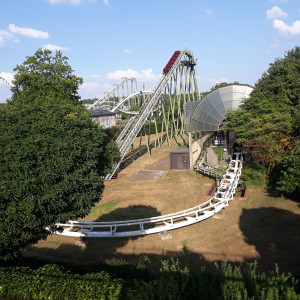
What's with launches like the 2nd one on Taron? How should such type of launch (mid-ride) perform in an E-Stop test? Should it be able to launch the train from a standstill after manually moving it to the beginning on the launch section? The realistic procedure like on Taron can't be done in NoLimits 2 (Launch the train backwards and then full power forwards).
Not always true, it's not part of every daily check for all coasters. For some, yes, that might be.
I'll concede that not every coaster performs this full level of block check every morning. I'm going off experience working at SFMM. However, during the initial break in testing of a new ride, every worst case scenario imaginable was tested at least once to ensure everything is working correctly as designed. So it's still a valid test to perform to make sure that trains stopped at any block brake for any reason can resume and continue the layout on their own.
What's with launches like the 2nd one on Taron? How should such type of launch (mid-ride) perform in an E-Stop test? Should it be able to launch the train from a standstill after manually moving it to the beginning on the launch section? The realistic procedure like on Taron can't be done in NoLimits 2 (Launch the train backwards and then full power forwards).
This is why the last bullet point exists: Complete true to life restarts aren't always possible due to the uniqueness of how some modern ride systems are programmed these days. On a ride like Taron, such a restart procedure has been programmed into the ride's functionality. Faced with such a design during judging, where a second launch is clearly meant to boost the speed more but not be a full restore point, concessions would be allowed in judging. This is especially true when dealing with custom scripting as there is no ready way to resume that moment in the script via manual control of the coaster. So in that case, if the coaster stopped safely without crashing, we'd reset the ride and go from there. The coaster does have to stop safely without crashing or violating block boundaries.
-Ride_Op
Hey folks,
Going from some feedback from this year's 5HOP live stream, I thought it would be good to officially define a standard for checks that are done as part of judging every contest. This first post will contain the official review criteria once it's agreed upon by everyone.
-Ride_Op