
The Official(?) FVD++ Friction Guide
[Archy from NLE]
Bolliger & Mabillard:Hyper
-with 8 cars N²=0.0314 FVD++=0.308Inverted
-with 8 cars use N²=0.0313 >FVD++=0.3071Twister/Floored
-with 6 cars use N²=0.0471 FVD++=
-with 7 cars use N²=0.0392 FVD++=
-with 8 cars use N²=0.0313 >FVD++=0.3071Floorless
-with 8 cars use N²=0.0313 >FVD++=0.3071Standup
-with 8 cars use N²=0.0337 FVD++=
Gerstlauer:
Eurofighter II
-with 1 car (obviously) use >N²=0.0280 FVD++=0.27468
GCI aka Great Coasters Int.
Millennium Flyer (Wooden, Trailored 2-Seat)
-with 12 cars use N²=0.0157 FVD++=
GG aka The Gravity Group
Wooden Coaster (Classic 4-seat)
-with 6 cars use N²=0.0157 FVD++=
Intamin:
Standard sitdown
-with 5 cars (ie, accelerator) use N²=0.0313 FVD++=
-with 8 cars use N²=0.0295 FVD++=
Maurer Söhne:
X car
-with 1 car use N²=0.0471 FVD++=
-with 2 cars use N²=0.0316 FVD++=
-with 3 cars use N²=0.0157 FVD++= 0.154017
Schwarzkopf
Looping Star/Silverarrow/Shuttle Loop (lap bar)
-with 6 cars use N²=0.0314 FVD++=
Vekoma:
Flying Dutchman
-with 1 car use N²=0.0469 FVD++=
-with 6 cars use N²=0.0313 FVD++=0.3071Suspended Looping (SLC)
-with 10 cars use N²=0.0321 FVD++=0.3149Sitdown
-with 7 car, use N²=0.0313 FVD++=
That’s just directly copied off the way back cache of the site. I know there are a lot of missing FVD values but there are some usefull ones there. There was also a friction calculator of some sort there iirc but I cannot speak to its usefulness.

Shouldn’t all the decimal points be moved a place to the left in archy’s list? That’s really odd.

^Yes, see Changelog of FVD++ v0.75, which changed the friction parameters to NL2 style.
Random drop of the info-bomb. This value (around 0.03) tells you how much energy the train loses per traveled track-length. With 0.03 the train loses 0.03m worth of potential energy per 1m traveled, or 0.03ft worth of potential energy per 1ft traveled. In other words, to keep the train running without friction drives, you need to angle the track by at least arcsin(0.03)=1.7°

Regards,
Lenny
altlenny posted on January 5th, 2018
Random drop of the info-bomb. This value (around 0.03) tells you how much energy the train loses per traveled track-length. With 0.03 the train loses 0.03m worth of potential energy per 1m traveled, or 0.03ft worth of potential energy per 1ft traveled. In other words, to keep the train running without friction drives, you need to angle the track by at least arcsin(0.03)=1.7°
Thanks so much! That makes testing so much easier to figure out the friction.

Hi there, what friction value should i use in FVD++ for an RMC Hybrid Coaster ?

If you're using CodeMaster's RMC trains and rails, use the friction value for the rocket coaster type since that's what you'll be attaching the trains to.
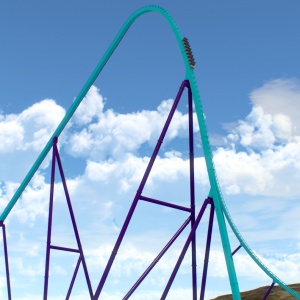
Keep in mind, topper track does have different friction. But for hybrid, steel friction is fine.
Hi ! I don't really understand the friction coefficient box in the Properties, what does it do, and should we change it from one coaster type to another ?
Coaster Blast posted on July 1st, 2019
Hi ! I don't really understand the friction coefficient box in the Properties, what does it do, and should we change it from one coaster type to another ?
As far as I can tell, it is the same as the 'Air Resistance Parameter' from NL2, as it says in the changelog for FVD 0.75: "NL2 style friction parameters".
The units don't seem to be updated from the original FVD++ friction parameter however. The tooltip on NL2 says it is the speed^2 friction simulation parameter with units 1/m. I assume this means the effect of the air resistance is proportional to the velocity squared. ie:
a = -β*(v^2)
Where a: acceleration (m/s/s), β: coefficient (1/m), v: velocity (m/s)
The units work out with this formula, so I assume this constant takes into account the mass and shape of the ride vehicle alongside other complex dependencies. I'll have to do a bit more playing around to see if this coefficient changes based on coaster type, amount of cars, etc. but it seems to be that the NL2 value for this is approximately 10.0E-05, rather than the FVD default of 2.0E-5.
I should also say the effect of this parameter is effectively negligible when compared with the main (m/m) friction parameter, the effect is so small it almost makes no difference. I'm talking maybe 1km/h throughout a 1km layout. If anyone else knows anything more than me or that I'm wrong on something feel free to let me know.
Hey guys, im trying to make a backyard roller coaster in FVD++ but i cant find the right friction values to use. the cart is about 80-100 pounds and i put in .275 for the friction value(euro fighter 2 friction value) since its the closest to my train, but it doesnt work correctly and runs for about 5 seconds before running out of speed. can anyone help me find the right values to use please, it would help so much
Eurofighters don't use 0.275m/m. They use 0.028m/m.
As for an actual backyard coaster, try 0.05m/m or so.
Posting the same thing three times won't get you faster replies.
Eurofighters don't use 0.275m/m. They use 0.028m/m.
As for an actual backyard coaster, try 0.05m/m or so.
Posting the same thing three times won't get you faster replies.
My apologies, not sure how this works but i wanted to make sure i got a reply cause i dont want my work to go to waste when i have to change fric value
Thank You for your help
Hi all,
I'm not satisfied with the friction data here. I tested some with a standard track in FVD++ and NL2. Results is that for the NL2.2 physics model, the friction values for steel coaster seem all the same and for woodies, too. Woodies are significantly better (weird? Why? Because steel on steel instead of steel on plastic? Or the 2 wheel vs 1 wheel set?). But the changes of train length do something, obviously, because the center of mass over a lift hill slightly drops the longer the train is. The additional mass pushing against the air does not seem to do anything. Also unrealistic, right?
Yet, we have not 1 but 2 values that need leveling if you want to export FVD++ tracks to NL2. And this is where I'm struggling a bit. Currently, it seems that 0.03 m/m for friction parameter and 0.00006 m/s² friction coefficient does work quite well for steel coasters. I'm mostly designing giant air-time machines on the B&M Hyper design. But it seems that the data is still not exact. Sure, one parameter is that a train does come with a wandering center of mass, while FVD++ does not considers this. But is this all? Did I hit the 0.03 and 0.00006 well or is there in fact something other at work?
Same for woodies, how is it there? The friction parameter must be somewhere in the range of 0.022 m/m. For the friction coefficient, no clue.
Does someone have insights on what the 2 values for different coasters are for NL2.2 physics model?
Thank you!
Cheers!
Aeneas posted on November 19th, 2024
Hi all,
I'm not satisfied with the friction data here. I tested some with a standard track in FVD++ and NL2. Results is that for the NL2.2 physics model, the friction values for steel coaster seem all the same and for woodies, too. Woodies are significantly better (weird? Why? Because steel on steel instead of steel on plastic? Or the 2 wheel vs 1 wheel set?). But the changes of train length do something, obviously, because the center of mass over a lift hill slightly drops the longer the train is. The additional mass pushing against the air does not seem to do anything. Also unrealistic, right?
Yet, we have not 1 but 2 values that need leveling if you want to export FVD++ tracks to NL2. And this is where I'm struggling a bit. Currently, it seems that 0.03 m/m for friction parameter and 0.00006 m/s² friction coefficient does work quite well for steel coasters. I'm mostly designing giant air-time machines on the B&M Hyper design. But it seems that the data is still not exact. Sure, one parameter is that a train does come with a wandering center of mass, while FVD++ does not considers this. But is this all? Did I hit the 0.03 and 0.00006 well or is there in fact something other at work?
Same for woodies, how is it there? The friction parameter must be somewhere in the range of 0.022 m/m. For the friction coefficient, no clue.Does someone have insights on what the 2 values for different coasters are for NL2.2 physics model?
Thank you!
Cheers!
NL2.2 has air resistance, especially at higher speeds. I’m pretty sure this is variable between coaster styles (not 100% sure) so if you want to get a 1:1 friction match in FVD with 2.2 it’s going to be damn near impossible if you’re building anything really above 100-200 feet I’d say. I personally use NL2 for my parameters, and with .24 friction in FVD I feel like the forces and speeds have been very close. So in my opinion using NL2 friction with .24 in FVD is the best option. However, someone else might have more insight into this than I do.
sidun10 posted on November 20th, 2024
NL2.2 has air resistance, especially at higher speeds. I’m pretty sure this is variable between coaster styles (not 100% sure) so if you want to get a 1:1 friction match in FVD with 2.2 it’s going to be damn near impossible if you’re building anything really above 100-200 feet I’d say. I personally use NL2 for my parameters, and with .24 friction in FVD I feel like the forces and speeds have been very close. So in my opinion using NL2 friction with .24 in FVD is the best option. However, someone else might have more insight into this than I do.
Thank you! This info helps a lot! The 0.024 m/m value in NL2 physics model, is it for wood or steel?
Aeneas posted on November 20th, 2024
Thank you! This info helps a lot! The 0.024 m/m value in NL2 physics model, is it for wood or steel?
Ok, I tested the NL2 value for steel coasters and it seems to be at 0.026 m/m and 0.00002 m/s²....
Aeneas posted on November 28th, 2024
Ok, I tested the NL2 value for steel coasters and it seems to be at 0.026 m/m and 0.00002 m/s²....
So now I have the test refined a bit. I tested a distance of 200 m with start v of 45, 90 and 180 km/h. both for wood and steel and NL2.2 and NL2. The results are this:
friction parameter (m/m) friction coefficient (m/s²)
steel NL2.2 0.026 0.0001
wood NL2.2 0.017 0.0001
steel NL2 0.026 0.00002
wood NL2 0.017 0.00002
Emonadeo and I were recently discussing friction values for FVD++, and he suggested that there should be a go-to list for these values, as "Archy's Friction List" did for Newton 2. So here it is!
I put a "?" after "official" because these values are not set in stone. The listed values (which should grow/change with your feedback) are merely values I have found work well with the select rides I've designed. Still, they have worked perfectly, or almost perfectly, with my rides. I am also not sure if NL2 changes the friction depending on how many cars a train has. It would be great if someone could confirm that.
Feel free to suggest more values or potential changes to these values and I will expand the list.
"Friction Parameter" values for FVD++:
B&M Tiered Hyper - 0.029
B&M Inverted - .031
B&M Flyer - 0.029
B&M Dive Machine - 0.031
Gerstlauer Infinity 2 - 0.03
Mack Launched - 0.03
Intamin Rocket - 0.03
GG Timberliner - 0.021